Every hiker knows the moment. The path tilts upwards, the conversation dries up, your legs start to burn and the summit seems to edge further away with every step.
Most people blame their lungs, and fitness certainly plays its part. But on a steep climb it's often your legs that give out first. The good news is that leg strength is one of the most trainable things there is. In this post we'll look at why uphill hiking is so demanding, the technique that makes climbs easier straight away, and the strength workout we use to help hikers climb stronger.
Why uphill hiking is so demanding
On flat ground, most of your effort goes into moving forwards. Going uphill, your legs also have to lift your whole bodyweight, plus your pack, upwards with every step. On a big day that adds up to thousands of steps, each one a small lift.
Research on incline walking backs this up. As a slope gets steeper, the muscles around the hips, knees and ankles all have to produce more force. The biggest increase is at the hip, where the glutes and hamstrings drive you up the hill. Studies measuring muscle activity have found that the glutes, hamstrings and calves all work noticeably harder on an incline than on the flat.
Two things make this harder still:
Every step is a single-leg effort. Whether it's a rocky staircase or a steep grassy slope, you're pushing your body up through one leg at a time. A big step up onto a rock is basically a weighted step-up.
Your calves work overtime. On steep ground your heels often don't touch down, so your calves end up doing a lot of the pushing, for a long time.
Put those together and climbing becomes a test of single-leg strength and how long your legs can keep producing it.
Technique: climb smarter before you climb stronger
Before we get to training, a few technique changes can make your next climb easier straight away.
Shorten your stride. Smaller steps mean a smaller lift each time. It might feel slow at first, but it's far more sustainable than big lunging strides.
Find a pace you can hold. Aim for a pace where you're breathing harder but could still say a short sentence. If you're stopping every few minutes to recover, you're going too fast. Steady and continuous beats stop-start.
Push through the whole foot. On big steps, place as much of your foot as you can on the step and drive up through it, rather than springing off your toes. This brings your glutes into the work and takes some strain off your calves.
Stand tall and lean from the ankles. A slight forward lean helps on steep ground, but try not to fold over at the waist. Hunching makes it harder to breathe and to use your hips.
Use the rest step on very steep ground. Between steps, pause for a moment with your weight on a straight back leg. It gives your muscles a fraction of a second off with each step, and it's a technique mountaineers have used for decades.
Consider poles. Poles let your arms share some of the work. Research suggests they reduce the load on your legs, although they make your heart and lungs work slightly harder. Many hikers also find they help with rhythm.
How strength training helps you climb
Technique helps you make the most of the strength you have. Training raises the ceiling.
Here's the simple version. If your legs are stronger, each step up uses a smaller share of what they can do. That means the same climb feels easier, and you can keep going for longer before your legs give out.
Research with endurance athletes supports this. A major review of studies on runners and cyclists found that adding strength training improved their performance and made them more economical, meaning they used less energy at the same speed. Hiking hasn't been studied in the same depth, but a climb asks the same thing of your legs: lots of repeated, single-leg effort.
For uphill hiking, we focus on four things:
Single-leg strength, so you can handle big steps and uneven ground one leg at a time.
Hip strength, because the glutes and hamstrings do much of the driving on a climb.
Calf strength, for steep sections where you're up on your toes.
Holding effort under fatigue, because the top of a long climb is where your legs need to keep going.
The Climb Strong workout
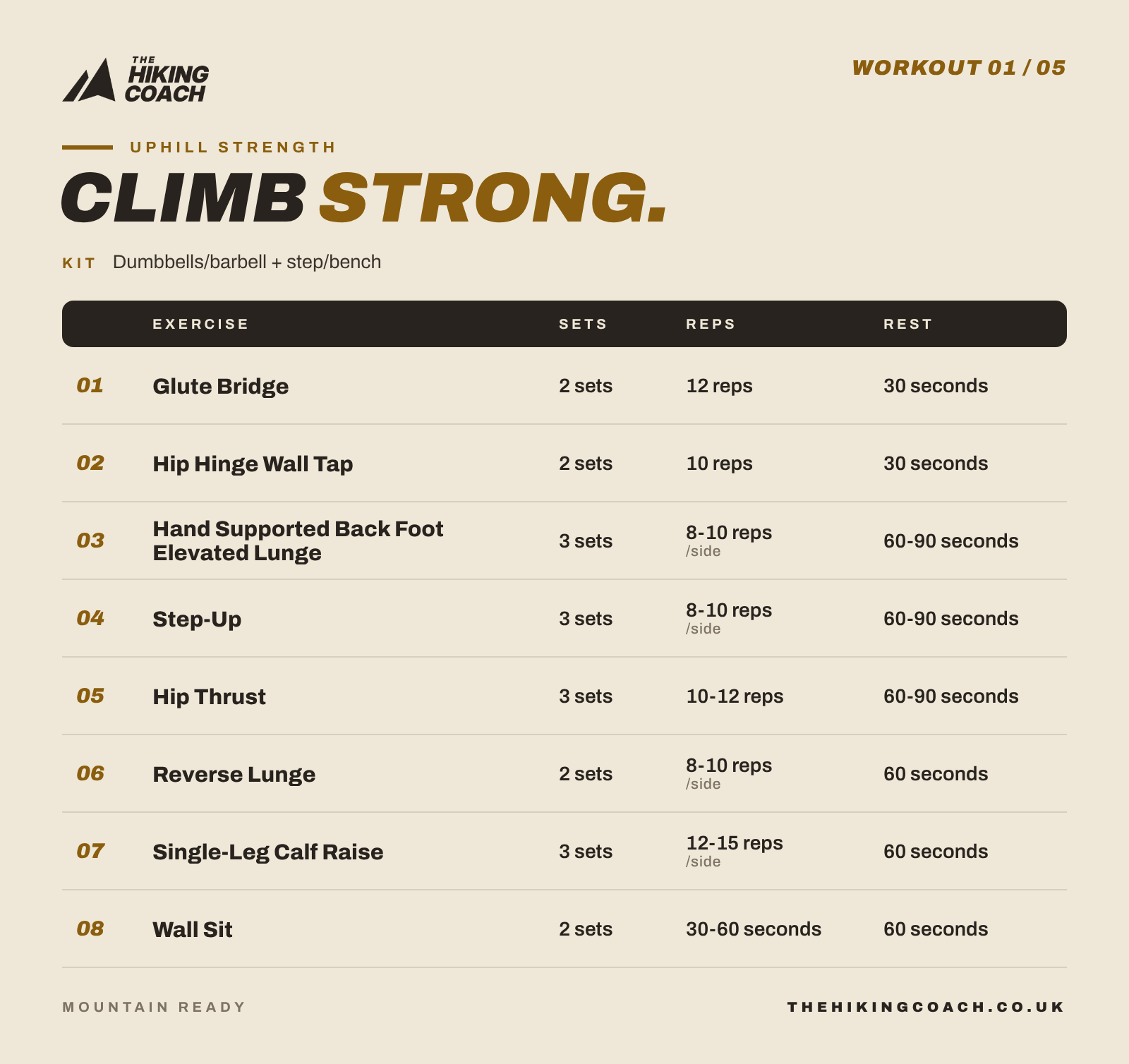
This is the uphill workout from our free 5 Hiking Workouts guide. You'll need dumbbells or a barbell, plus a step or bench.
Complete all the sets of one exercise before moving on to the next. Choose a weight that leaves you with about two reps in the tank at the end of each set. It should feel hard, but your technique shouldn't break down.
How it fits together
Glute Bridge and Hip Hinge Wall Tap get your hips working and grooved before the heavier work.
The back foot elevated lunge and step-up are the heart of the session. They're single-leg, they work the hips and thighs together, and the step-up is about as close to a climb as you'll get in the gym. Use a step height similar to the big steps you meet on the hill, and control the way back down.
Hip Thrust loads the glutes, the muscles that do much of the work driving you uphill.
Reverse Lunge adds more single-leg volume once you're already a little tired, much like the top half of a long climb.
Single-Leg Calf Raise builds the calves for steep sections. Go through the full range, from a deep stretch to high on your toes, and hold something for balance.
Wall Sit finishes the session by asking your thighs to hold effort while they burn. It's a useful taste of the last stretch of a big climb.
How often? One or two sessions a week alongside your normal hiking is a great start. When you can hit the top of the rep range with two reps still in the tank, increase the weight a little.
If you have an injury or health condition, check with a qualified healthcare professional before starting a new exercise program.
Climbs are only half the story
What goes up must come down, and descents ask something quite different of your legs. If steep descents leave your thighs shaking, read our guide to downhill strength next.
Get all five workouts free
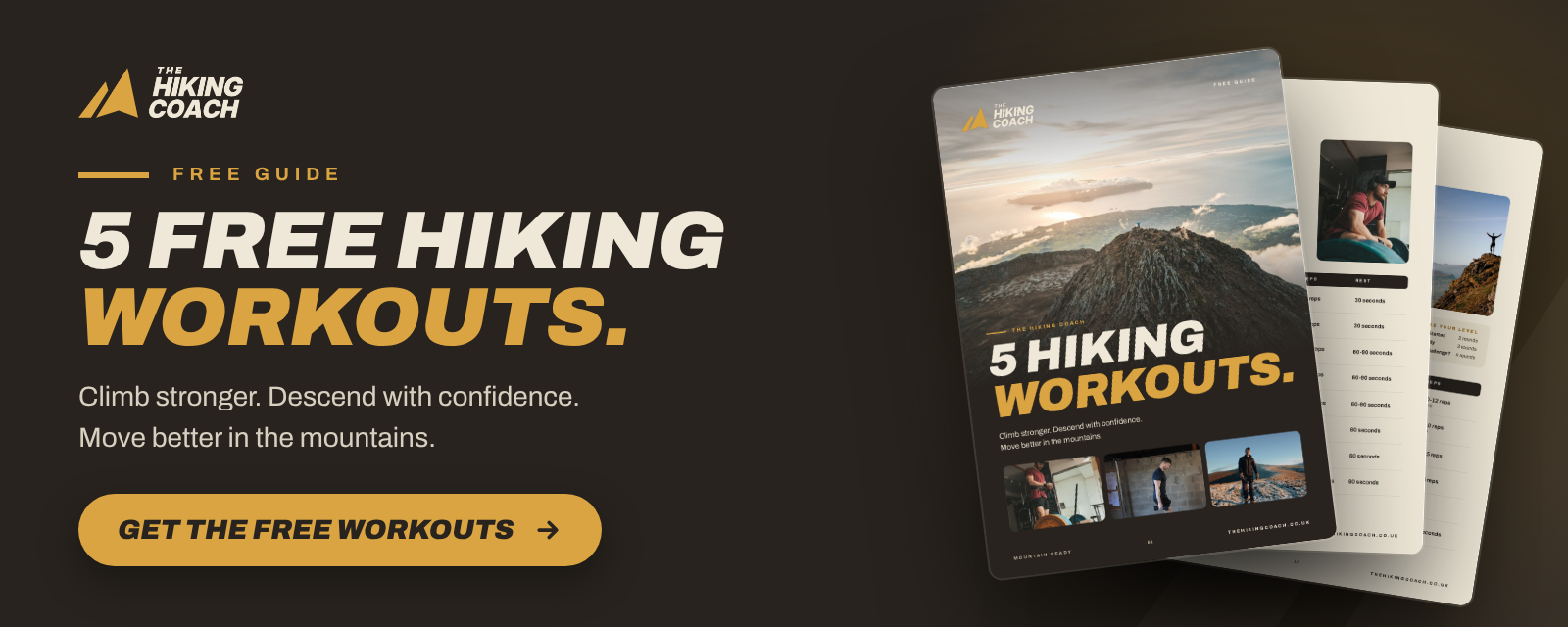
Climb Strong is one of five workouts in our free guide, 5 Hiking Workouts. You'll also get a descent workout, a mobility flow, an at-home bodyweight session and a conditioning circuit, all with sets, reps, rest times and video demonstrations.
Want a full plan?
One workout is a great start. A structured program is how you keep improving week after week.
The Hiking Coach app has an ever expanding library of progressive programs built for hikers.